

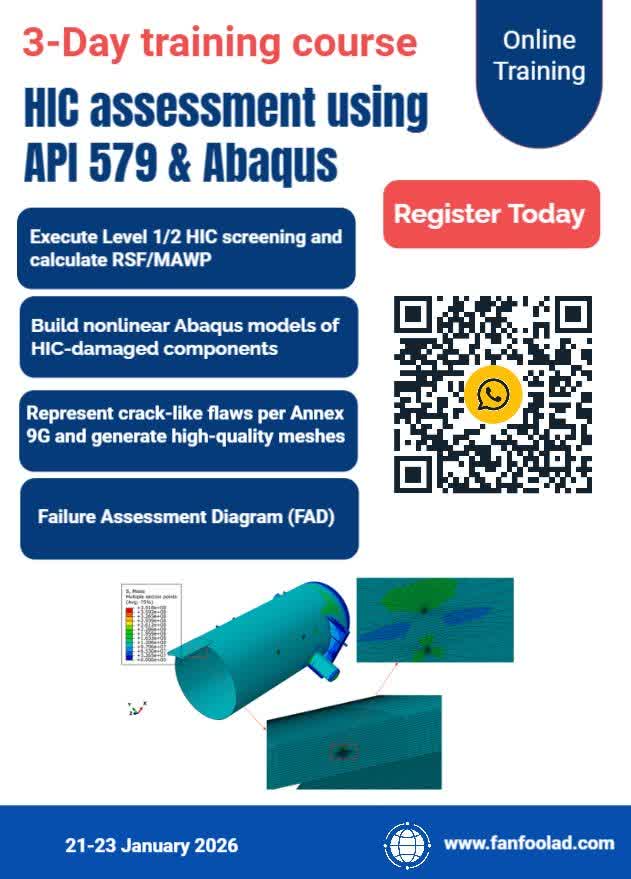
Advanced Assessment of Hydrogen Damage Using API 579 & Abaqus (FEM + Classical K-Approach)
This intensive course equips engineers with the skills to perform Level 3 Fitness-for-Service (FFS) evaluations of hydrogen-induced cracking (HIC) using API 579 Part 7 and Part 9 (Annex 9G). Participants will learn to model damage using nonlinear finite element methods (FEM), extract fracture parameters, and make integrity decisions based on Failure Assessment Diagrams (FAD).
🎯 Learning Outcomes
By the end of this course, participants will be able to:
1. Explain hydrogen damage mechanisms and API 579 Part 7 requirements
2. Perform Level 1 & 2 HIC screening and calculate RSF/MAWP
3. Build nonlinear FEM models of HIC-damaged components in Abaqus
4. Represent crack-like flaws per Annex 9G and generate high-quality meshes
5. Extract Mode I stress intensity factors (K), compute Lr, and use FAD for integrity decisions
6. Integrate inspection data into a comprehensive Level 3 FFS report
📅 Day 1: Fundamentals of Hydrogen Damage & FFS
Focus: API 579 Part 7, screening methods, and nonlinear FEM modeling
• Overview of API 579 structure, Part 7 scope, and related annexes
• Annex 2C: required thickness, RSF, and MAWP calculations
• Level 1 & 2 screening: methodology, assumptions, and escalation criteria
• Level 3 workflow overview: when and how to apply FEM
• Translating NDT outputs into model-ready inputs
• Material degradation modeling: stress-strain curves, damage zones
• Nonlinear solution strategies: convergence, and stabilization
📅 Day 2: Crack Modeling & Fracture Mechanics
Focus: Annex 9G crack representation, meshing, and fracture parameter extraction
• Annex 9G geometry rules for surface and embedded flaws
• Meshing strategy: element types, refinement zones, and crack-front control
• Mesh quality metrics: aspect ratio and convergence sensitivity
• LEFM principles in FEM: assumptions, limitations, and validation
• Abaqus tools for extracting Mode I stress intensity factor (K)
• Computing Kr and Lr for FAD construction
📅 Day 3: Integrated Level 3 Workflow & Reporting
Focus: Simulation validation, decision-making, and reporting
• Validating FEM results: mesh convergence, sensitivity, and uncertainty
• Decision-making using Kr/Lr: repair, mitigation, or continued operation
• Integrating multi-source inspection data for complex geometries
Course Fee: $2,000 USD
Includes training materials, Abaqus model templates, and post-course support resources.
Presenter: Shahabaldin Zangeneh, PhD